Journal entry: Mid - term
Mid term –
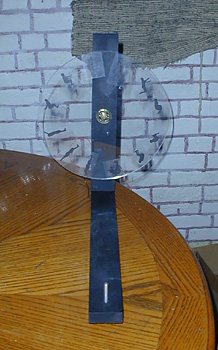
I created a spinning wheel with still images on it, which when flashes
with a strobe light created the illusion of movement. The speed of the
spin and frequency of the strobe controlled by the user. Not a totally
new concept just new to me. This project was based on the works of Toshi
Iwa, which were presented to ITP in September. His work intrigued me on
many levels. He told old ideas and re-made them using new material and
technology. My spinning wheel is similar to the 1st movies created.
To created the still images I shot video of myself doing a flip. I then
spent a day taking creating still out of the movement on the video. Final
Cut Pro allows one to take still images of movies. I found the quality
of these still to be quite bad. I ended up spending more time doing this
than I expected. But that is par for the course around here. I put the
stills in PhotoShop and turned them into silhouettes. I decided I would
use 12 images. I could have created smaller images and used more, that
might have been better. But the 12 worked out fine. I printed the 121
images out on 8.5x11 and to it to Kinko’s to have copied onto acetate.
I envisioned the piece being suspended on the wall, with the spinning
wheel on the wall and an arm coming out which the strobe and the controls
were attached. I used a 12v motor to spin the wheel. In the mock up I
made I found that the Pot would heat up quite a bit, I thought I was due
to the small Pot, 10k, I was using, so for the finished project I switched
to a larger one, 100k. But still the Pot would start to smoke after a
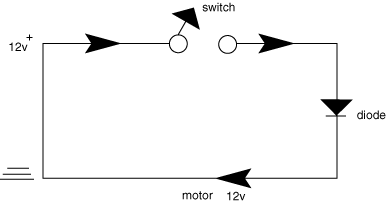
few minutes of use. Maybe there was too much load on the Pot. Here is
the very basic diagram of the board:
My original idea was to use a proximity sensor for the switch. This would
make the interaction a bit more interesting. As the viewer stepped up
to the wheel on the wall, it would start spinning. Then the user could
control the speed of the strobe and the speed of the wheel spin. I had
to settle for the potentiometer because the proximity sensor can only
output 3v and the motor needs 12 to run. The idea was to use an OpAmp.
The OpAmp is a small chip, which is used to add to power sources together.
The problem was that the wiring of the OpAmp is not well documented. Jen
Lewin and I spent the better part of 3hrs trying to figure out which wires
went where. The only output we were successful in obtaining was the difference
between the two power sources not the additive amount. We then tried a
TIP 120 transistor but that also did not give enough power to the motor.
I decided against using a BX24 because it would only send out a "pulse"
to the motor and therefore not giving the wheel the smoothest movement.
I thought the wheel project worked out ok. Not great, ok it did what I
hoped it would do. I might be fun to create a whole wall or say about
10 different spinning wheels, which could be controlled by a user. Or
since I used clear plastic for the surface of the wheel, it might be interesting
to see if the spinning images could be projected on to a wall. The one
aspect I will continue to pursue is the OpAmp problem. What is the wiring
for it and where can that be found. I found this link to a pdf document:
http://webug.physics.uiuc.edu/courses/phys343/spring01/343exp/Lab3/Lab3.pdf.
Maybe it will help.